In the West, the affordability challenge is inseparable from the resilience challenge.
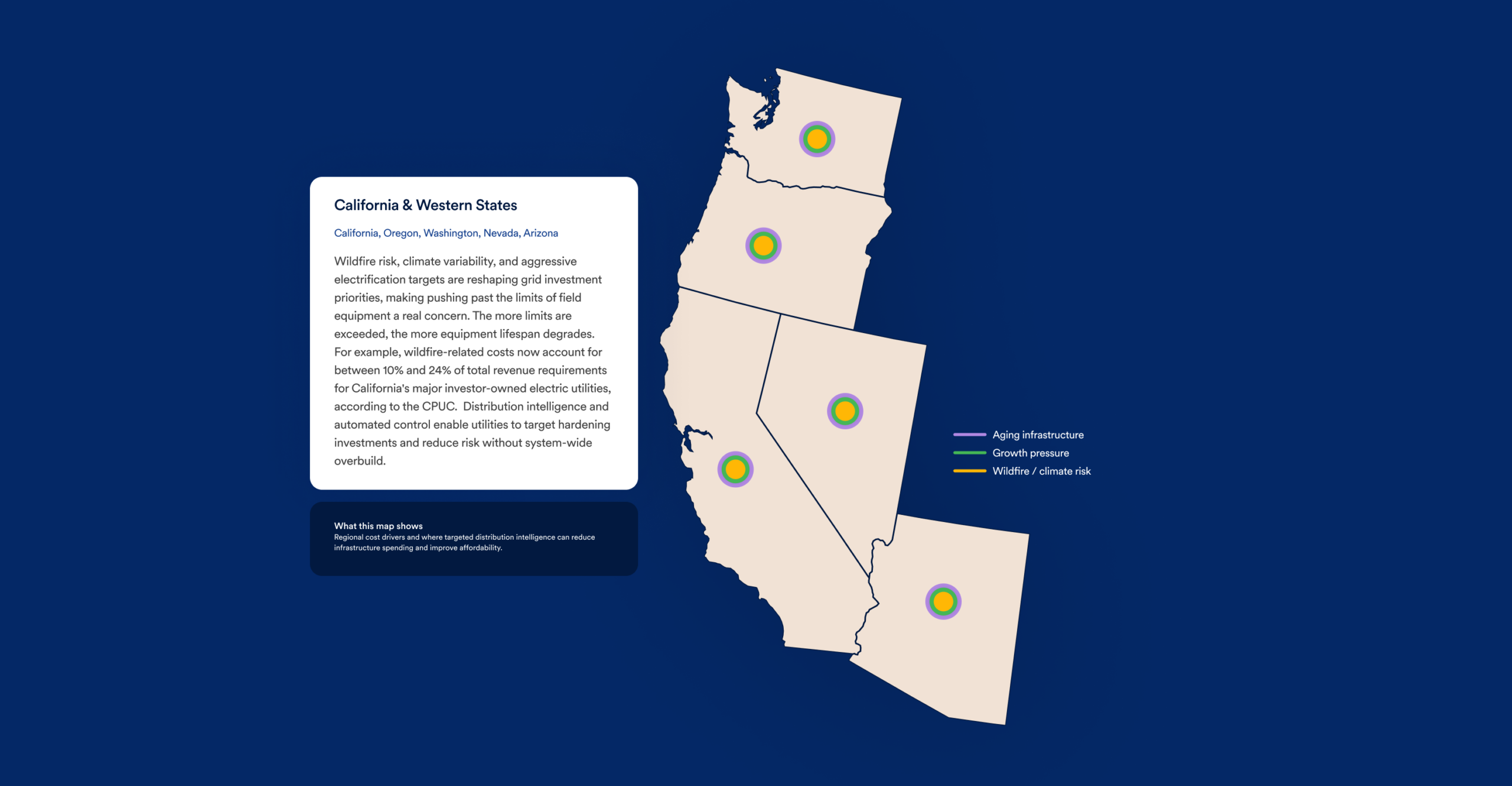
California, Oregon, Washington, Nevada, and Arizona face a volatile mix of wildfire risk, heat, drought, and rapid electrification. Utilities must strengthen infrastructure against more extreme conditions while preparing for new demand from electrification and the increased variability brought on by climate change.
That creates a consequential question for utility leaders and regulators: how can the West reduce risk and add load without building the entire distribution system for the most extreme conditions everywhere, all the time?
The answer starts with a more precise view of the problem. Grid pressure is not uniform. It emerges at particular locations, around particular assets, and during particular windows of time. The most useful wildfire mitigation technology for utilities does more than identify system-wide risk; it helps reveal where conditions are changing and where intervention is most valuable. If utilities can see those conditions earlier and act locally, they can target hardening, manage load, and extract more capacity from the grid already in place.
The cost of resilience is already an affordability issue
Wildfire mitigation is necessary, urgent, and expensive. The California Public Utilities Commission Public Advocates Office reported that between January 2023 and April 2024, wildfire-related costs, including vegetation management, grid hardening, and rebuilding damaged infrastructure, accounted for 10% to 24% of the total revenue requirements of California’s three major investor-owned electric utilities.
It is not just utilities that pay the price. According to the California Public Utilities Commission, from 2019 through the fourth quarter of 2024, California’s investor-owned utilities were authorized to collect approximately $27 billion for wildfire mitigation costs.
Those figures expose the central tension. Utilities cannot compromise on safety, but neither can they treat every mile of network, every feeder, and every piece of field equipment as if it faces the same risk at the same moment.
The Western grid is a network of highly specific conditions. Dry vegetation and high winds can turn one corridor into an ignition threat. Extreme heat can push a neighborhood transformer toward its operating limit. New EV charging can create a sharp evening peak on one feeder while capacity remains available nearby. A system-wide average can conceal all three.
When visibility is limited, the rational planning response is conservative: build for the worst case. That approach protects reliability, but applied too broadly it can produce expensive overbuild and accelerate costs for customers.
The broader reliability framework reinforces that conservative planning instinct, although the distinction between transmission and distribution matters. NERC standards and reliability assessments apply primarily to the bulk power system, not individual distribution feeders, transformers, or other grid-edge assets. They require planners to demonstrate that sufficient resources and reserves will be available during peak demand, contingencies, and other stressed conditions. They do not require utilities to build a particular distribution asset.
But that reliability imperative influences planning throughout the system. Utilities must be able to show that capacity will be available when it is needed, not merely that it exists during most hours of the year. When localized data is incomplete, conventional infrastructure can be easier to validate as a dependable solution than targeted flexibility or operational changes. The result is not overbuilding mandated by NERC, but a planning environment in which uncertainty can favor construction. Better grid-edge intelligence gives utilities stronger evidence for determining where additional infrastructure is essential and where load management, maintenance, or another targeted intervention can meet the need safely.
From meter data to operational intelligence
Utilities across the West have invested significantly in advanced metering infrastructure. Much of that first generation was designed primarily to support meter-to-cash functions, remote service operations, and outage notification. Those capabilities created an important foundation, but the changing grid now demands more.
AMI 2.0 expands the role of the meter from a periodic data-collection device into a distributed sensing and intelligence platform. High-resolution measurements, edge processing, and advanced analytics can provide utilities with more immediate and localized insight into load behavior, voltage conditions, power quality, abnormal signatures, and emerging faults.
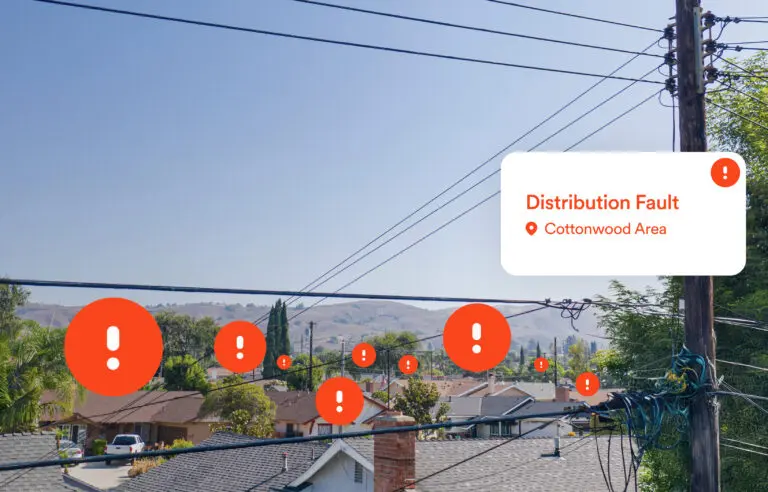
That distinction matters in wildfire-prone regions. Traditional meter data may confirm that an outage or failure has occurred. Higher-resolution grid-edge intelligence can help identify unusual conditions earlier, locate them more precisely, and distinguish routine activity from patterns that warrant investigation.
The value of better intelligence is that it can help these measures work together more precisely. A utility may use localized insight to investigate a suspected fault, reduce stress on a constrained asset, prioritize maintenance, or determine that physical replacement is necessary. The technology does not dictate a single response. It gives operators better information for selecting the appropriate one.
Sense’s Waveform AI supports this evolution by transforming continuous, high-resolution signals at the meter into actionable intelligence for the grid and the home. Processing data at the edge can surface meaningful events more quickly, reduce communications burdens, and provide localized visibility at a scale that centralized analysis alone can’t support.
This is the promise of AMI 2.0: not simply collecting more data, but turning the grid edge into an operational resource that helps utilities recognize risk earlier, manage changing loads more precisely, and direct limited time and capital where they can have the greatest effect.
A more affordable grid is a more precise grid
Better grid-edge intelligence can help utilities direct wildfire-mitigation investments toward the assets and locations where physical intervention is most urgent. High-resolution sensing can identify abnormal conditions, emerging faults, and localized asset stress that broader system data may obscure. That visibility helps utilities distinguish situations requiring hardening or replacement from those where maintenance, protective action, or load management may safely reduce risk. It can also reveal when short-duration stress, rather than persistent capacity need, is driving an apparent constraint.
The result is a more precise resilience strategy that protects reliability without treating every asset as equally vulnerable or every constraint as a construction problem. Utilities can concentrate limited capital where it will have the greatest safety impact while making better use of the infrastructure already in place.
The West does not face a choice between hardening the grid and keeping electricity affordable. It faces a choice about how it does both.
California and the Western states are already on the front line of climate risk and electrification. They can also lead the next phase of grid modernization, one that protects communities while protecting customers from the cost of unnecessary overbuilding.
Wildfire resilience starts with hardening. More affordable resilience starts with knowing precisely where, when, and how to act. That intelligence starts at the grid edge.
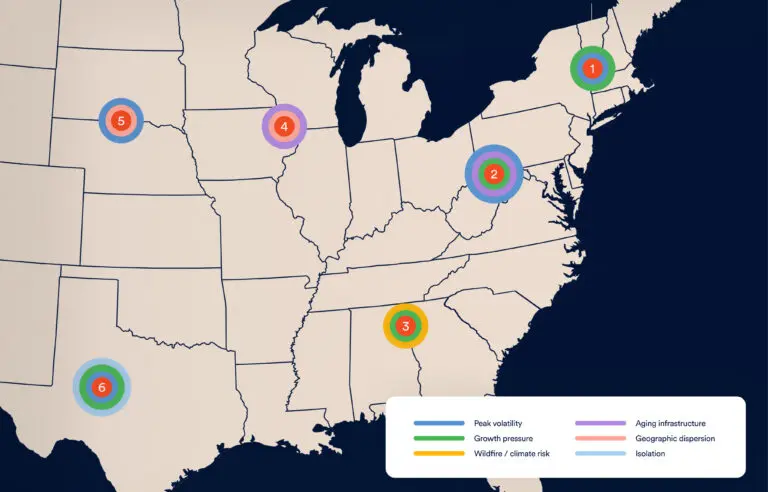
Energy affordability is one of the defining challenges for utilities and customers across the United States. That is the focus of our new white paper ‘More From the Grid We Have’ where we explore how local constraints differ by region, from winter peaks in New England to rapid load growth in Texas.