
Most people have no idea what’s actually happening inside their home’s electrical system. Which devices are quietly running up the bill? Which ones are behaving strangely? Which ones are costing far more than they should? Sense is built to change that, giving you real-time visibility, fewer surprises, and clear paths to save.
Here’s how it works, and how to get there faster.
How Sense learns your home
Sense collects 4 million data points every second from your electrical panel, building a unique electrical “fingerprint” for every device in your home. No cameras. No manual labeling. Just physics.
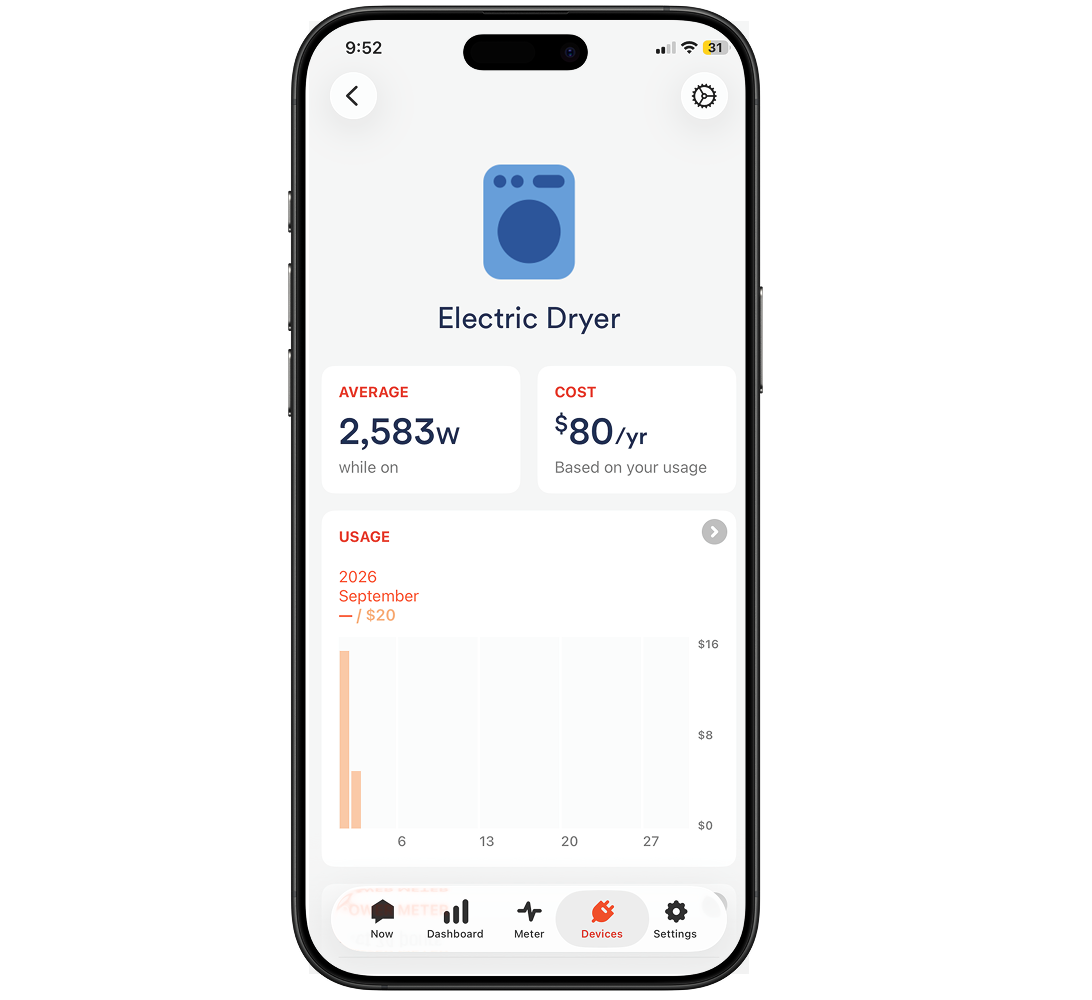
The challenge is that most devices aren’t simply on or off. Your dishwasher cycles through fill, wash, rinse, drain, and standby — each phase looks different in the data. Your dryer almost always follows your washer. Your microwave typically runs in multiples of 30 seconds. Sense picks up on these real-world patterns to tell one device from another.
That’s also why trying to shortcut the process (like turning a device on and off rapidly to “train” Sense) can backfire. Those artificial patterns strip away the very context that makes detection accurate. The best thing you can do is use your home normally. Sense learns from the real thing.
Why it takes time (and why that’s a feature, not a bug)
Sense learns from two places at once. It starts with labeled data from thousands of homes, so it already knows what common devices look like. Then it studies patterns specific to your home. The tricky part is that your home is never quiet: the fridge, the furnace fan, and a dozen chargers are all running at once. To pick out one device’s signature, Sense has to see it turn on and off many times, against all that background noise. That takes time, but it’s what makes detection accurate instead of a guess.
Two refrigerators from different manufacturers look different in the data. Your wiring, your habits, the unique combination of devices running at any moment, all of it shapes the model. That specificity is what makes detection accurate rather than just approximate.
It takes time because it’s doing something genuinely hard. But every day Sense runs, it’s getting closer and building an understanding of your home that’s truly yours.
How you can help Sense get there faster
We have introduced a variety of features that take advantage of user input to help improve device detection in your home and for the entire user base.
- Connect your networked devices
- Network Identification allows Sense to recognize devices that broadcast signals over your home network.
- Fill in what you know about your devices
- Renaming devices, adding make and model info, and completing your Home Details gives the data science team a real signal that sharpens detection across the whole community.
Start exploring right now with no detections required
You don’t have to wait for Sense to identify a single device to start learning about your home.
Open the Power Meter and watch your home’s energy use in real time. Then start experimenting: turn on your oven and see the number jump. Run the dishwasher and watch what it draws through each cycle. With Watt Check, you can flip off a light and see exactly how much it was pulling. It’s actually pretty fun and useful!
Then check your Always On number. This is the baseline power your home consumes 24/7, even when you think everything is off. For most households, it’s higher than expected and it’s typically where the easiest savings are hiding. That number is available to you from day one.